
Brno Tech Region Climbs Global Innovation Rankings in 2026
Strong Foundations, Faster Competition
In the Global Startup Ecosystem Index 2026, which evaluates startup ecosystems across more than 100 countries and 1,500+ cities, the Czech Republic placed 32nd globally – two spots lower than last year, but still the strongest ecosystem in Central Europe. Poland follows (33rd), with Hungary (53rd), Slovenia (57th) and Slovakia (59th) further behind. Within the EU, Czechia ranks 15th.The two-place dip is less a sign of weakness than of a field that is moving faster. The Czech ecosystem grew 15.9% year-on-year.
Where Czechia genuinely stands out is in the conditions it offers: 30th globally in the Innovators Business Environment Index and 11th in Europe for ecosystem attractiveness, reflecting a strong R&D base, credible institutions and growing international appeal.
On the legislative side, the past year has brought the establishment of the Czech Startup Association, a draft Startup Act that would for the first time define startups in law, and meaningful reforms to employee stock ownership rules (ESOP).
Brno in the Top 200 Globally
Czechia now has four cities in the global top 1,000 startup hubs – Prague at 83rd, Brno at 190th, Ostrava at 750th, and Olomouc re-entering at 960th. The relationship between Prague and Brno is worth pausing on: Prague's total score in GSEI is only 2.8 times that of Brno — well below the ratio typical of comparable European ecosystems, where capital cities tend to dominate far more completely. Brno is not a satellite; it has its own gravity.Brno grew 21.9% year-on-year in GSEI, a positive trajectory that nonetheless left it four positions lower as peer cities at a similar global tier outpaced it. That pattern reflects the fundamental dynamic facing mid-sized European tech hubs right now: the global field is accelerating, and pace matters as much as direction.
"Brno's position in international rankings is shaped by what has been built here over years," says Petr Chládek, director of JIC innovation agency. "The region has established a globally relevant position in cybersecurity, electron microscopy, aerospace and chip design. In the past five years alone, companies that originated here have raised more than €300 million. That is the result of the whole local ecosystem."
Dealroom's Index: Productivity Per Capita
The Dealroom Global Tech Ecosystem Index, released in May 2026, evaluates 325 city-level hubs across 77 countries through three lenses – absolute scale (Global Champions), innovation output per capita (Density Leaders) and growth trajectory (Rising Stars). For a city of Brno's size, the Density Leaders ranking is the most meaningful: it is specifically designed so that smaller, highly productive hubs are not simply buried under the volume of larger cities.Here, Brno ranks 156th out of 325, up 7 places. That improvement means Brno is generating more per capita – more venture activity, more enterprise value, more startup founders from local universities – relative to its peer group. It is the ranking where the region's model of concentrated, specialised innovation shows up most clearly.
In the Global Champions ranking, which measures raw scale, Brno climbed 9 places to 219th. The number that stands out is total funding growth of +439%, placing Brno in the 90th percentile globally. The Dealroom methodology deliberately reduces the weight of funding growth to prevent smaller cities from artificially inflating their position on the back of a low base – which makes this figure more credible, not less.
Cybersecurity: A World-Class Cluster
The sector-level data from Dealroom is where Brno's story becomes most distinctive. In cybersecurity, Brno ranks 38th in the world in absolute terms – an extraordinary position for a city of its size, and one that reflects a cluster that has been building since the late 1990s. Prague ranks 36th in the same category. Taken together, the two Czech cities give the country a cybersecurity footprint that rivals ecosystems many times its scale.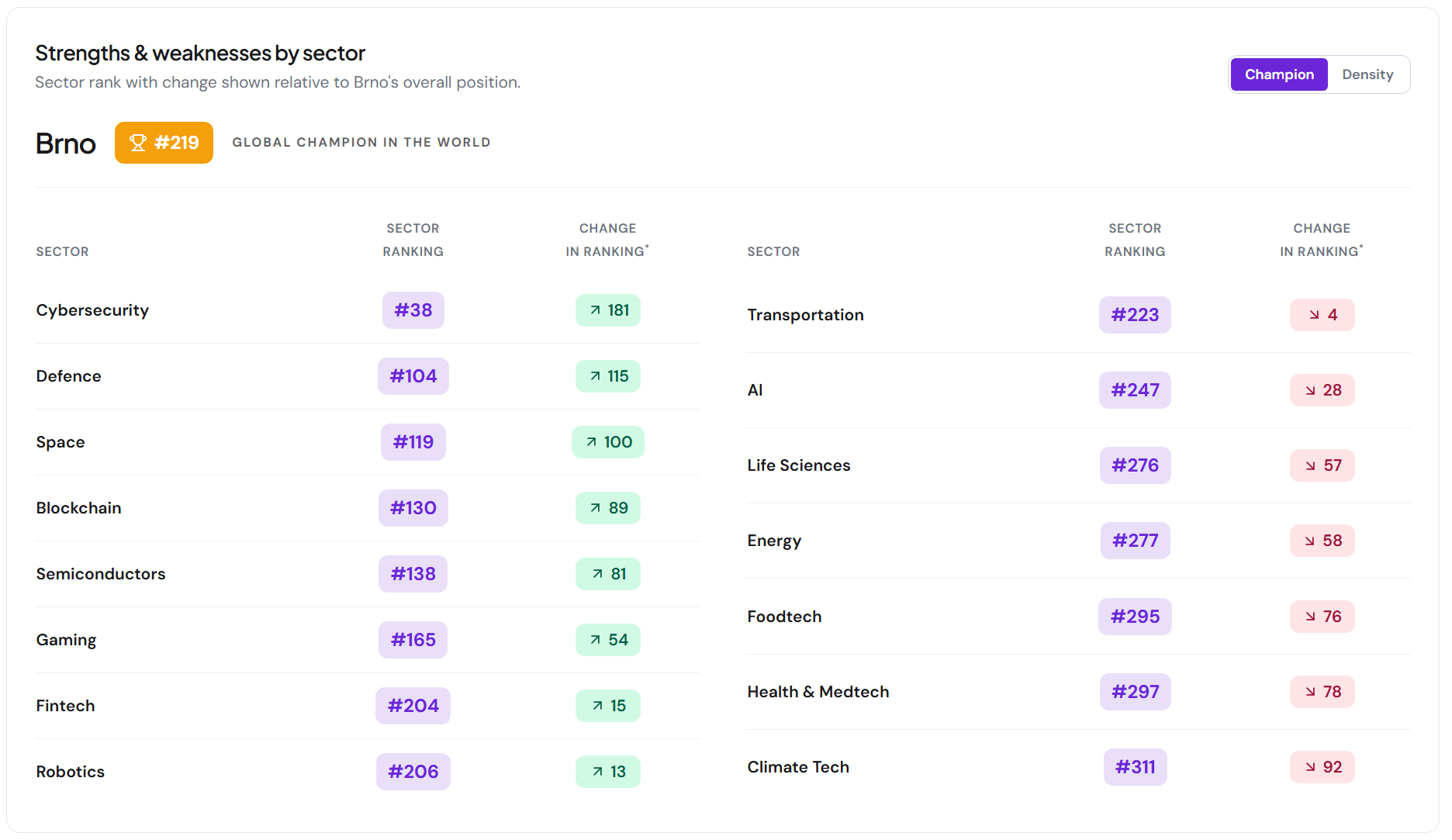
That cluster did not emerge from nowhere. Brno's cybersecurity story runs deep into the region's technical DNA: some 1,500 cybersecurity experts work here today, and over the past two decades, investments into local companies have exceeded €1.5 billion. Global players chose Brno as a development base – Gen Digital, SolarWinds, ESET, Jamf, Dynatrace and Progress all maintain significant teams here, in several cases having arrived through acquisitions of locally built companies such as Flowmon Networks and Runecast Solutions. The OpenSSL Software Foundation relocated to Brno in 2025.
Alongside these established names, a new generation of companies is gaining international traction: Whalebone is on course to protect 1.6 billion users worldwide, ThreatMark's ScamFlag solution won the European AI Award, and together with Safetica, these three companies alone raised close to €40 million from investors in the first months of 2025. Underpinning all of this is a national standing that lends the ecosystem credibility: the Czech Republic ranks first globally in the National Cybersecurity Index, which measures countries' readiness to face cyber threats.
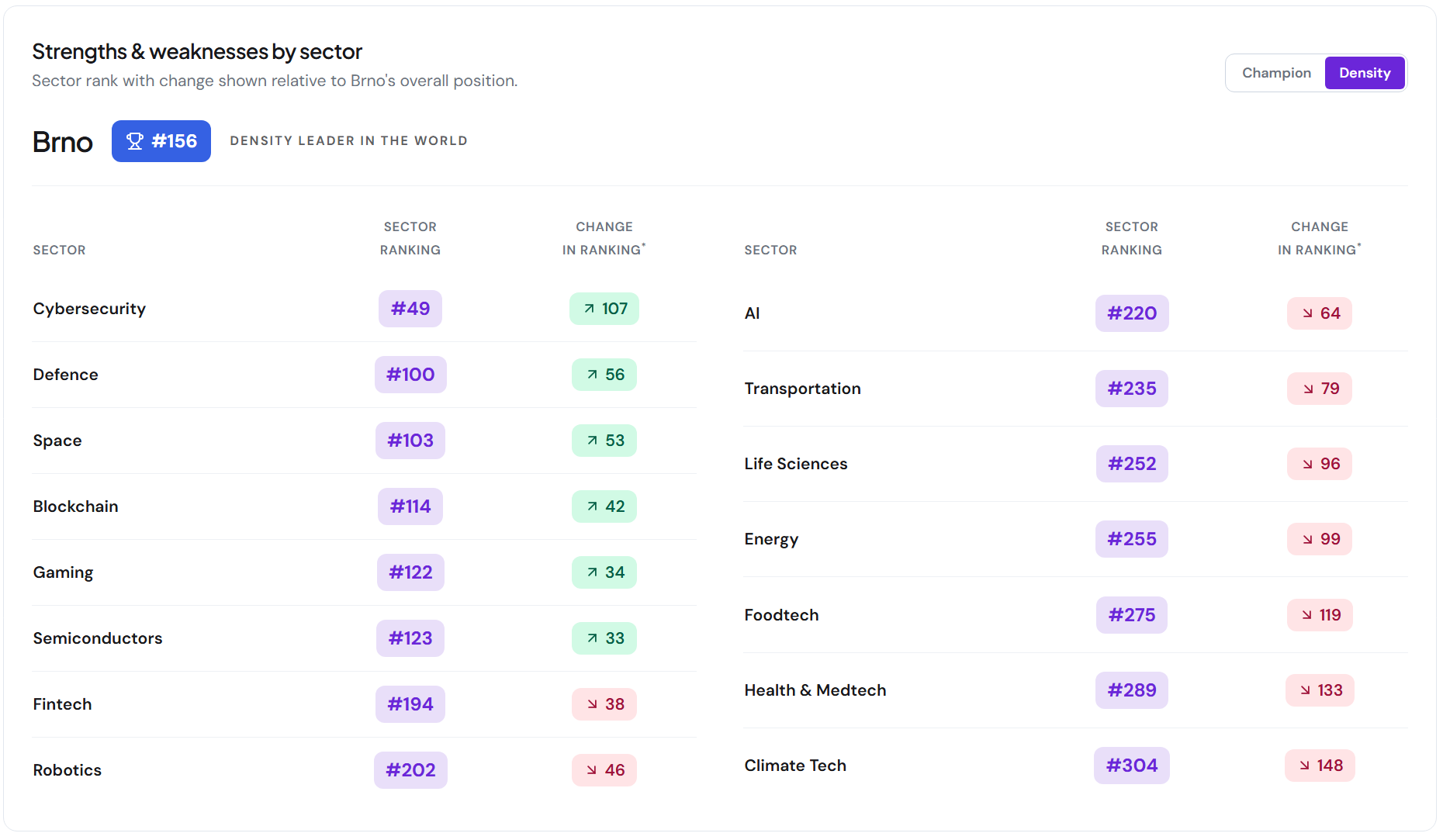
In the per-capita (density) view, Brno also shows positive momentum in space, gaming and semiconductors – sectors aligned with the region's strengths in advanced engineering and chip design. These are earlier-stage signals, but density improvements in technically complex, niche sectors tend to precede broader ecosystem growth.
What the 2026 results confirm is that Brno's position is earned, not inherited – built on specialisation in fields. The clearest opportunity ahead is widening that base: more companies forming around the cybersecurity and deep-tech talent that already exists, more capital flowing into a region that has demonstrated it can deploy it, and more international visibility for an ecosystem that, by the measures that matter, already ranks among the world's most productive for its size.
Read more about the topic
The Brno Region is emerging as one of Europe’s rising technology hubs, according to the latest annual data report published by JIC, the Czech innovation agency. Driven by sectors that are increasingly relevant to the continent’s competitiveness, resilience and security, the Czech second-city region is building momentum in cybersecurity, chip design, electron microscopy, aerospace, defense and space technologies — and investors are taking notice.
Na jaře 2025 došlo k zásadní události ve světě laboratorní diagnostiky: mezinárodní investiční fond ARCHIMED koupil společnost BioVendor Group, která patří mezi klíčové hráče na evropském trhu moderní laboratorní diagnostiky. Nešlo o dramatický obrat, ale o promyšlený krok, který měl posílit vývoj, expanzi a dlouhodobou konkurenceschopnost skupiny. Co firmě první rok pod křídly nového strategického partnera přinesl?